
How to Get a Railing Approved by Your San Ramon HOA
Why HOA approval comes first
HOA railing approval in San Ramon is usually the first hurdle, not the last. If your home sits in a community with CC&Rs, a new deck rail, balcony rail, front porch railing or side-yard gate is an exterior change, and many HOAs require architectural review before any work starts.
Order matters because of the building permit. Pleasanton's building permit application asks whether the property is subject to HOA design review, and the owner must have HOA approval before submitting. Other Tri-Valley departments may not ask the same question, but starting with the HOA keeps you from paying for a permit on a design the committee later rejects.
Below is what committees typically want to see, the questions to ask before you submit, and how we package the drawings so you are not starting from a blank form. Questions about your own project? Call (925) 438-6219.
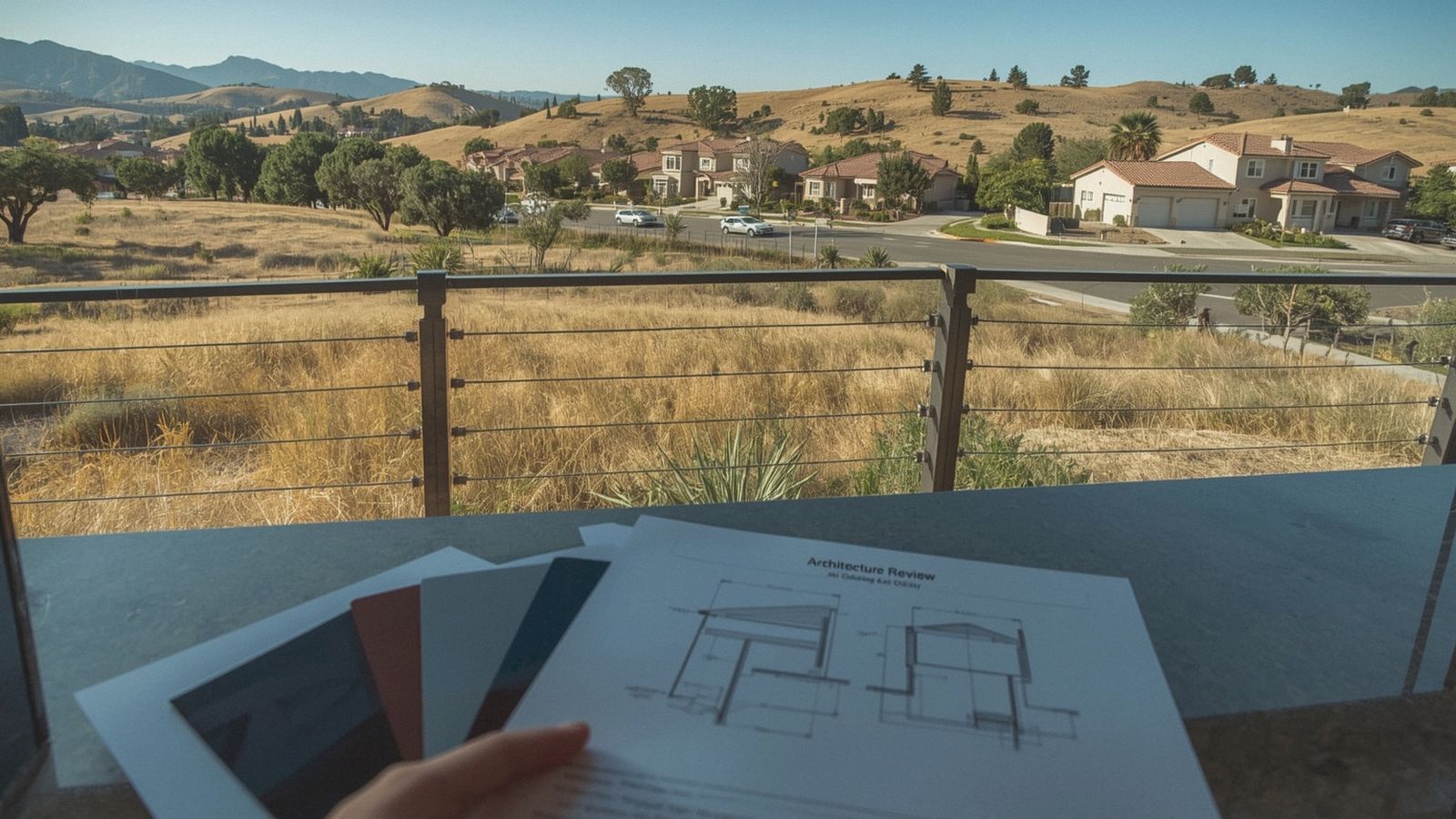
What to include in your architectural application
Every association writes its own form, but the strongest railing submittals tend to include the same pieces:
| Item | What it shows the committee |
|---|---|
| Completed application form | Owner, lot, scope of work, contractor information |
| Shop drawing (elevation and section) | Height, baluster spacing, post spacing, profile, mounting |
| Finish and color sample | The actual powder coat chip or a manufacturer color card |
| Photos of the existing condition | What is there now, from the street and the yard |
| Site plan or marked-up plot plan | Where the railing or gate goes and its length |
| Product cut sheets | Glass, cable or aluminum system details, if used |
| Neighbor notice, if required | Some associations ask adjacent owners to sign or be notified |
Incomplete packages are a common reason for delay, so ask the management company for the current checklist before you send anything. Keep a copy of everything you submit, along with the date it went in.
Planning a railing project in San Ramon or the Tri-Valley? We measure on site for free and give you a written range before anything is fabricated.
What belongs on the railing shop drawing
A committee member should be able to read the drawing without calling anyone. We include:
- Overall length of each run and the location of every post
- Finished height (42 inches for a guard on an elevated deck or balcony; 34 to 38 inches for a stair handrail)
- Baluster or cable spacing, noted to pass the 4-inch sphere rule
- Profiles of the top rail, posts and any decorative elements
- Mounting method: surface plates, fascia brackets or core-drilled posts
- Material and finish callout, matched to the color sample
The same drawing later becomes the backbone of the permit set, so building it right once saves a second round of drafting.
For balconies and second-story decks, we also note how the rail meets the house wall and whether any stucco or siding will be cut. Committees tend to ask about exterior wall penetrations, and answering up front avoids a second round.
Matching neighborhood standards
Master-planned and gated communities are where many HOAs require architectural review: Dougherty Valley in San Ramon, Blackhawk near Danville, Ruby Hill and Kottinger Ranch in Pleasanton, and Rossmoor in Walnut Creek, where alterations in the Mutuals are coordinated through the property management office. Each sets its own rules, so read your own CC&Rs and design guidelines instead of relying on what a neighbor did.
Committees approve faster when a railing looks like it belongs. Practical ways to get there:
- Photograph two or three approved railings on your street and match their color family and profile.
- Choose a standard color such as a black or dark bronze powder coat if the guidelines name one.
- For views, cable or glass with dark posts tends to read quietly from the street.
- On front elevations, keep ornament consistent with the house style.
Questions to ask your committee before you submit
- When does the committee meet, and what is the deadline to make that meeting's agenda?
- When is an application considered complete, and how will I be told if something is missing?
- What is the maximum response time in your procedures?
- Is a deposit or review fee required?
- Does approval expire if work does not start by a certain date?
- Will approval come with conditions, such as work hours or a final inspection by the HOA?
- Do neighbors need to be notified or sign?
California's Davis-Stirling Act (Civil Code section 4765) requires associations to have a fair, reasonable and expeditious review procedure with prompt deadlines. Decisions must be in writing, and a denial must explain why and describe how to request reconsideration by the board. Ask for your approval letter in writing before ordering materials.
Common reasons a railing application comes back
Most returned applications are not outright denials. They come back with a request for more information or a small change. The usual culprits:
- No color sample. A color name on a form is not enough for many committees. A physical powder coat chip settles the question in one meeting.
- Vague dimensions. "Standard height" or "approx. 40 feet" invites a follow-up letter. Give exact heights, run lengths and post spacing.
- Missing context photos. Committees want to see how the rail reads from the street or common area, not just a close-up.
- Style mismatch. Heavy scrollwork on a clean contemporary elevation, or a bright finish where guidelines call for earth tones.
- Unclear scope. If the deck surface, stairs or lighting are also changing, say so now. Adding scope after approval often means a new application.
A complete package also helps the building inspector later, because the approved drawing and the permit drawing tell the same story.
How we help with HOA submittals
We prepare the shop drawings, bring finish samples to the free on-site estimate, take the existing-condition photos and mark up your plot plan. If the committee asks for changes, we revise the drawings and resubmit. Because we fabricate in our own shop, we can also make a small sample piece or show a finished baluster profile when a committee wants to see the real thing rather than a picture. Once approved, the same package moves into the city or county permit when one is needed. See our HOA and condo railing services, browse wrought iron railings and cable railings, and read our San Ramon railing permit guide for the next step.
Ready to start? Call (925) 438-6219 or book a free estimate and mention your HOA so we bring the right samples.
FAQ
Questions, Answered
Straight answers on cost, code, permits and materials. Still unsure? Call and ask.
Do I need HOA approval to replace a railing with the same design?
Many associations still want an application for like-for-like replacement, especially if the color, material or profile changes even slightly. Some exempt exact replacements. Read your CC&Rs and architectural guidelines or ask the management company in writing. A short email confirming no review is needed protects you if a question comes up later.
Which comes first, the HOA approval or the building permit?
Get HOA approval first. Pleasanton's permit application asks whether the property is under HOA design review and expects approval before submittal, and starting with the HOA elsewhere avoids paying for a permit on a design the committee might change. We use the same drawings for both, so the permit step goes faster after approval.
What if my HOA denies the railing?
Under Civil Code section 4765 the denial must be in writing, explain why, and describe how to request reconsideration by the board. Read the reasons closely; most denials come down to color, height or profile and can be fixed with a revised drawing. We can adjust the design and help you resubmit.
Can you attend the HOA meeting with me?
If the committee allows contractors to attend and the schedule works, we are glad to answer technical questions about the drawings, finish or mounting. Many committees decide on the paperwork alone, which is why we put the time into a complete, clear package from the start, with dimensions, a finish sample and photos that answer the usual questions before anyone has to ask them.
Need Help in San Ramon?
San Ramon Custom Railing builds custom iron, cable, glass and aluminum railings across San Ramon, CA and the Tri-Valley. If this guide answered your question, the next step is a free on-site measure and a written range. See everything we do on our homepage, or reach out now.